
Your Lead Magnet Isn’t the Problem. Your Follow-Up Is
May 15, 2026
The Mid-Year Marketing Check Nobody Does (But Everyone Needs)
June 12, 2026
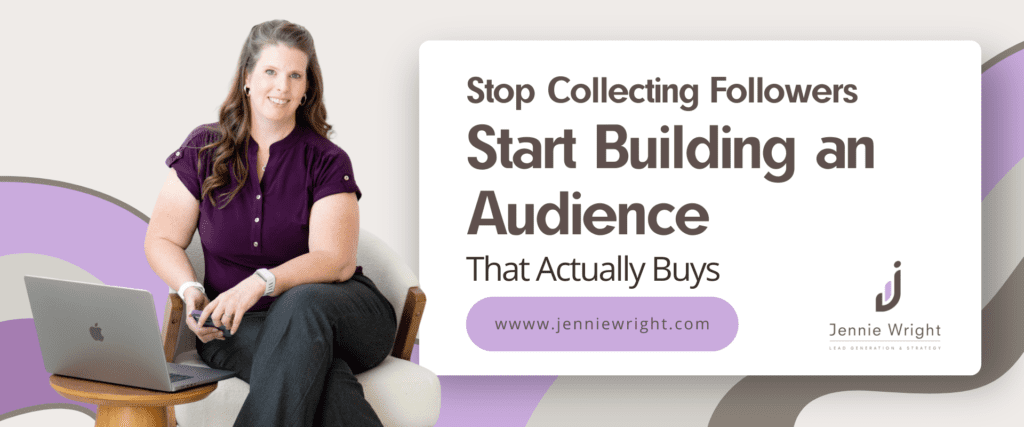
I’ve been on both sides of this. I’ve had a decent social following and a business that was genuinely struggling to pay the bills, and I know what that particular cognitive dissonance feels like because it’s hard to explain to anyone outside of this world without sounding like you’re complaining about a problem that shouldn’t exist. The followers were there. The content was getting engagement. And when I went to launch something, the results didn’t come close to matching what the numbers suggested should be possible.
It took me a while to understand why, but once I did, it changed how I think about audience-building entirely, and it’s the thing I find myself coming back to with almost every client I work with who is frustrated that their social presence isn’t translating into revenue the way they expected it to.
Followers and audiences are not the same thing, and that distinction matters a lot
A follower is someone who clicked a button, usually because a single piece of content caught their attention at a specific moment. They may have resonated with that one thing without being particularly interested in what you do, what you sell, or the problem you help people solve. They found you, they followed, and now they scroll past most of what you post because the thing that got their attention that day isn’t necessarily the thing you talk about consistently.
An audience is something different. An audience is built over time through consistent, relevant content that earns attention rather than just capturing it. These are the people who recognise your name in their inbox and open your emails because they’ve learned you’re worth opening. Who refer people to you because they actually understand what you do. Who engage with your content because they’re paying attention to you specifically, not just to whatever happens to land in their feed that afternoon.
The difference matters enormously when you go to sell something. Followers are a vanity metric. An audience is a business asset. And you can have a very large number of one without having much of the other.
Why big numbers can hide the real problem for a long time
When your follower count is growing, it’s genuinely easy to interpret that as business traction. The number goes up, posts get saved, someone tags a friend occasionally, and all of it reads like momentum. I’ve been there and I understand why it feels that way. The problem is that follower growth and revenue are not the same metric, and using one as a proxy for the other will keep you in a loop of putting effort into something that feels productive without producing the outcomes you actually need.
Beyond that, followers on social platforms aren’t yours. They exist in someone else’s ecosystem, subject to someone else’s algorithm, and the day that platform decides your organic reach needs to drop, those followers become significantly less accessible without ad spend. I’ve watched people build what looked like a thriving online presence and then have the rug pulled out by an algorithm change they had no control over and no way to recover from, because they hadn’t been building anything they actually owned.
The number that matters is how many people you can reach directly, consistently, without an algorithm in the middle deciding who sees it. That’s your email list, and that’s the thing most people underinvest in while they’re busy chasing a follower count that feels more visible but does a lot less work.
What it actually looks like to build an audience instead of a following
I’ll be honest that it’s slower, because it is. Building an audience that trusts you enough to buy from you requires consistency over a long enough period that people genuinely learn to depend on your presence, and trust has a time component that can’t really be hacked. You can shortcut visibility with the right content or the right collaboration. You can’t shortcut the accumulated weight of showing up reliably over months and making it worth someone’s time every single time you do.
The mechanics of it aren’t complicated, but the follow-through is harder than it sounds. You need a reason for people to join your list that’s directly connected to the specific problem you solve, not just a generic freebie that any content creator in your niche could offer. You need to show up in their inbox on a predictable schedule, not only when you have something to sell, and when you do show up, the content needs to feel like it was worth opening. It needs to be specific, relevant, and useful in a way that reinforces the reason they gave you their email address in the first place.
The other piece, and this is the one most people underestimate, is letting your emails feel like they’re coming from a real person. Not a brand. Not a marketing department. Someone who has an actual opinion, a specific experience, a point of view that you can’t get anywhere else. That’s what makes someone want to stay on a list, and it’s what makes them actually read what you send rather than just letting it pile up.
A question worth sitting with
If you sent an email to your list today, not a promotional email but a genuine, specific, useful one about something your audience is actually dealing with right now, how many people would open it? How many would reply? And if someone who had been on your list for six months was asked to describe what you do and why you’re worth paying attention to, could they do it accurately?
Those questions will tell you more about the health of your audience than your follower count ever will. And if the answers make you a bit uncomfortable, that’s actually useful information, not a reason to panic, but a clear signal about where to focus your energy.
If you haven’t already read it, Stop Chasing Clients: The “Let Them” Marketing Philosophy connects directly to this conversation. It gets into what happens when you stop trying to manage every outcome and start trusting that the right people will find their way to you when your marketing is doing its job properly.
Building a list that actually performs is something we work through with clients regularly, looking at what’s coming in, what’s happening after the opt-in, and where the relationship is breaking down before it gets to a sale.
If you want a clearer picture of where your audience-building is working and where it’s not, book a strategy call and let’s look at it together.
We’ve also covered audience quality versus quantity on the Acquire Podcast, including the specific things that make the difference between a list that grows and a list that converts. Listen here.

I'm Jennie, and trust me, I've been where you are.
You’re trying to scale your business, and it’s not just about growth, right? It’s about finding those clever tweaks and big moves that really pay off. It’s about knowing which lever to pull and when. I get it because I’ve been through that maze too. That’s exactly why I started my business.
I wanted to create a place where driven folks like us could get our hands on the strategies that make a real difference. I’m all about sharing the insider secrets, the ones that help you scale smart and keep your business steady while you climb.
I believe that it’s not just about tips and tricks. I’m your guide, your support, and your biggest fan, all rolled into one. I’m here to show you the ropes, so you can make those bold moves and watch your business soar.
Ready to take the leap? I’ve got your back.
The Benefits of a Fractional CMO
More Bang for Your Buck
Life’s all about change, especially in business, and a fractional CMO’s got the agility to switch gears fast to keep your strategy fresh and focused.
Ready to Pivot at a Moment’s Notice
With a fractional CMO, you’re tapping into a goldmine of know-how from all kinds of industries – they’ve seen it all and know what sticks.
Treasure Trove of Tricks from Every Trade
With a fractional CMO, you’re tapping into a goldmine of know-how from all kinds of industries – they’ve seen it all and know what sticks.
Fast-Track Your Growth
A fractional CMO is like a boost button for your business, spotting opportunities and setting them in motion quicker than you can say ‘scale up’.

Related posts