
Stop Chasing Clients: The “Let Them” Marketing Philosophy for Sustainable Growth
February 6, 2026
I Didn’t Plan to Be a Marketer. I Just Kept Saying Yes to the Work No One Else Wanted.
March 6, 2026
- business automation strategy
- business infrastructure
- business process optimization
- business systems strategy
- CRM consolidation
- digital tools for entrepreneurs
- founder decision making
- founder focus
- Go High Level strategy
- leadership and systems
- marketing systems clarity
- marketing tech stack
- operational efficiency
- reducing business complexity
- SaaS overload
- scaling operations
- simplify your business tech stack
- software consolidation for businesses
- system design for growth
- tech stack simplification
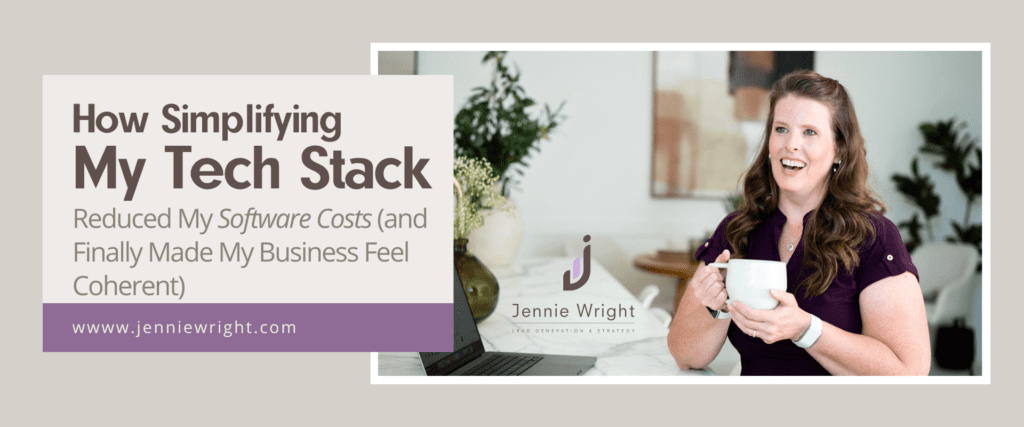
There is a particular kind of discomfort that shows up at the beginning of the year, especially for business owners who have been operating at a high level for a long time, and it has very little to do with revenue goals or strategic planning and everything to do with the creeping awareness that some part of the business has become heavier than it needs to be.
Not broken.
Not failing.
Just… unnecessarily complex.
For many people, that weight lives in their software stack.
Not because software is inherently bad, or because systems are optional, but because somewhere along the way, the accumulation of tools starts to feel like progress, and the act of simplifying begins to feel suspiciously like regression, even when your intuition is quietly telling you that something has gone off course.
I know this because I lived it.
When “Having Systems” Quietly Turned Into Managing Chaos
There was a period in my business where I was spending over $700 USD a month on software alone, which, as a Canadian business owner, translated into a kind of low-grade financial irritation that I kept justifying as the cost of doing business at a certain level.
At the time, I could have listed every tool and given you a perfectly reasonable explanation for why each one existed.
ThriveCart handled courses.
ActiveCampaign handled email.
ClickFunnels or Leadpages handled landing pages. (honestly I have such a disdain for Leadpages – sorry)
Calendly handled scheduling.
Zapier handled… everything else, mostly by force.
Layered on top of that were proposal tools, invoicing platforms, form builders, social schedulers, and a handful of “temporary” subscriptions that had somehow become permanent simply because I never made the time to reassess them.
What makes this particularly ironic is that I wasn’t anti-systems or casually dabbling in tech — I was actively teaching people how to build operational infrastructure. I understood automation. I believed deeply in creating leverage. And for a while, I equated a larger tech stack with a more mature business.
That assumption turned out to be incomplete.
The Cost I Wasn’t Accounting For
The real problem wasn’t the monthly spend, even though the number eventually became hard to ignore.
The real problem was the cognitive overhead.
Every decision required context switching. Every small change meant logging into multiple platforms, remembering how they interacted, checking whether an automation would break if one system updated before another, and mentally reconstructing workflows I hadn’t touched in weeks.
By the end of the day, I wasn’t tired because I’d done meaningful strategic work. I was tired because my attention had been fragmented across too many tools, too many dashboards, and too many places where things could quietly fail.
That kind of fatigue doesn’t show up neatly in a profit-and-loss statement, but it absolutely affects the quality of your thinking, your leadership capacity, and your ability to make clean decisions.
The Incorrect Conclusion I Reached First
Like most competent business owners, my first instinct wasn’t to simplify — it was to optimize.
I assumed the solution was better documentation, tighter SOPs, clearer internal processes, and more discipline around how the tools were used.
And while those things are important, they were ultimately treating the symptom, not the cause.
The truth I didn’t want to admit was this: the more tools you stack, the more your business depends on brittle integrations, workaround logic, and a constant state of low-level vigilance to keep everything functioning.
Hope, as it turns out, is not a scalable operating system.
The Decision That Actually Changed Things
Eventually, I stopped asking how to manage the stack more effectively and started asking a different question altogether: What would it look like if this business ran from one central nervous system instead of a collection of loosely connected organs?
That shift changed everything.
I consolidated into a single core platform capable of handling courses, landing pages, CRM, email marketing, scheduling, automations, and funnels — not because that platform was perfect, but because consolidation itself was the strategy.
In my case, that platform is Go High Level, though the specific tool matters far less than the principle behind the choice.
One login.
One source of truth.
One place to diagnose issues when something doesn’t behave as expected.
The migration process was neither glamorous nor particularly enjoyable, but it was intentional, finite, and ultimately clarifying — which is more than I can say for the slow bleed of managing an overgrown tech ecosystem.
What Simplification Actually Gave Me
Yes, the financial savings were real. I now save roughly $5,000 USD per year, which is meaningful in its own right. That’s a new team member, that’s investing in the future… It’s so much!
But the deeper impact was structural.
My business became easier to reason about.
My team onboarded faster because everything lived in one place.
Reporting stopped feeling like an archaeological dig through disconnected systems.
Most importantly, my attention — which is the most valuable asset any founder has — stopped being consumed by software maintenance and returned to strategy, growth, and leadership.
That is not a small shift. It is the difference between running a business and being slowly run by it.
If Your Tech Stack Feels Heavy, Pay Attention
You do not need more tools to look legitimate.
You do not need complexity to signal sophistication.
And you certainly do not need to keep paying for subscriptions out of fear that cancelling them will somehow limit your future options.
You do need systems — but systems should reduce friction, not introduce it.
If you are feeling a quiet resistance every time you open yet another dashboard, or a subtle dread at the thought of launching because of how many moving parts are involved, that is not a discipline problem. It is a design problem.
And design problems can be fixed.
If you want help figuring out what to keep, what to cut, and how to simplify without breaking your business in the process, book a call and let’s map it out properly.
Because the goal is not to impress people with how complex your systems are.
The goal is to build something that actually supports the way you want to work.

I'm Jennie, and trust me, I've been where you are.
You’re trying to scale your business, and it’s not just about growth, right? It’s about finding those clever tweaks and big moves that really pay off. It’s about knowing which lever to pull and when. I get it because I’ve been through that maze too. That’s exactly why I started my business.
I wanted to create a place where driven folks like us could get our hands on the strategies that make a real difference. I’m all about sharing the insider secrets, the ones that help you scale smart and keep your business steady while you climb.
I believe that it’s not just about tips and tricks. I’m your guide, your support, and your biggest fan, all rolled into one. I’m here to show you the ropes, so you can make those bold moves and watch your business soar.
Ready to take the leap? I’ve got your back.
The Benefits of a Fractional CMO
More Bang for Your Buck
Life’s all about change, especially in business, and a fractional CMO’s got the agility to switch gears fast to keep your strategy fresh and focused.
Ready to Pivot at a Moment’s Notice
With a fractional CMO, you’re tapping into a goldmine of know-how from all kinds of industries – they’ve seen it all and know what sticks.
Treasure Trove of Tricks from Every Trade
With a fractional CMO, you’re tapping into a goldmine of know-how from all kinds of industries – they’ve seen it all and know what sticks.
Fast-Track Your Growth
A fractional CMO is like a boost button for your business, spotting opportunities and setting them in motion quicker than you can say ‘scale up’.

Related posts